What Is Premeditated Murder in Massachusetts?
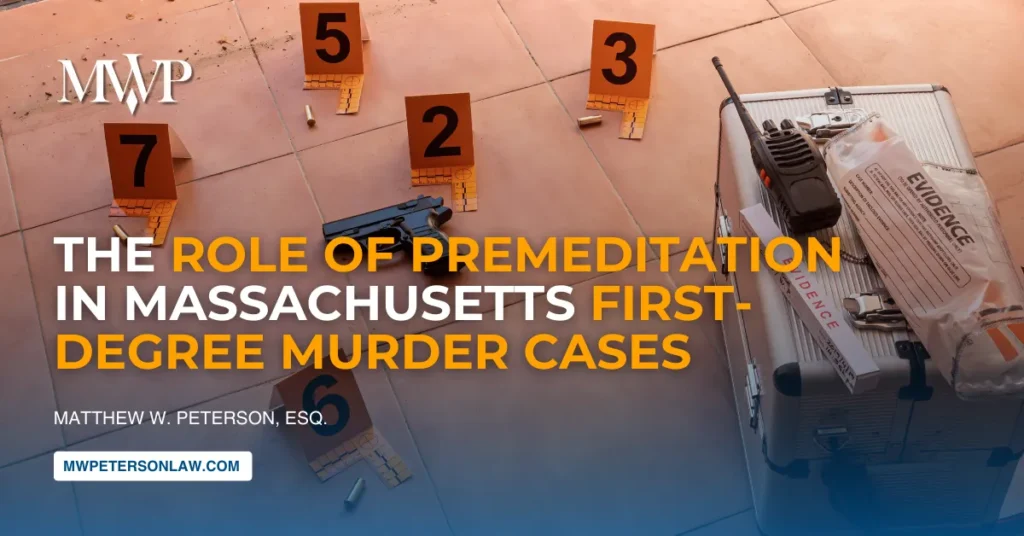
In Massachusetts, first-degree murder represents the most serious criminal charge a person can face. A conviction results in mandatory life imprisonment without the possibility of parole, making the legal distinctions within these cases critically important.
Massachusetts law recognizes three theories of first-degree murder:
- Deliberate premeditation, malice aforethought
- Extreme atrocity or cruelty
- Felony murder
This article focuses specifically on deliberately premeditated malice aforethought, the theory most commonly misunderstood by the public.
Many people assume premeditated murder requires days or weeks of planning. In reality, Massachusetts law applies a far broader standard. Under the state’s interpretation, even a brief moment of thought, if it qualifies as deliberate, can elevate a killing to first-degree murder. That standard is known as the cool reflection rule, and it is often the central battleground in homicide trials.
How Long Is “Premeditation”? The Massachusetts Cool Reflection Rule
One of the most important and most dangerous features of Massachusetts homicide law is that premeditation has no required duration. The law does not demand advance planning, scheming, or long-term contemplation. Instead, the prosecution must show that the defendant formed the intent to kill after a moment of calm reflection, however brief.
Premeditation may exist even if the decision to kill occurred seconds before the act, so long as the jury believes the defendant had time to think, decide, and then act. The focus is not on how long the reflection lasted, but on whether the killing resulted from a conscious decision rather than a purely impulsive reaction.
This distinction is critical because it separates first-degree murder from killings committed in situations such as:
- Heat of passion
- Sudden combat
- Rapidly escalating confrontations
Those scenarios may still result in criminal liability, but they often support second-degree murder or voluntary manslaughter, which carry dramatically different sentencing consequences. Massachusetts courts consistently emphasize that premeditation is about the quality of thought, not the clock.
Evidence Prosecutors Use to Prove Deliberate Premeditation
Because intent exists in the defendant’s mind, prosecutors almost always rely on circumstantial evidence to prove deliberate premeditation. They invite the jury to infer intent from actions, statements, and surrounding circumstances rather than direct admissions.
One common prosecutorial approach is emphasizing planning or preparation. This may include actions such as obtaining a weapon, bringing it to the scene, or positioning oneself before the confrontation. Prosecutors argue these steps demonstrate time for reflection, even if that time was brief.
The Commonwealth also frequently relies on motive and prior statements, pointing to arguments, threats, hostile messages, jealousy, or longstanding disputes. These facts are used to suggest the defendant had a reason to want the victim dead and acted on that desire after reflection.
Finally, prosecutors often focus on the manner of killing. Factors such as multiple wounds, targeting vital areas, or continuing the attack after the victim was incapacitated may be presented as evidence that the act was deliberate rather than spontaneous. Each detail becomes part of a narrative intended to show that the defendant decided to kill and then carried out that decision.
Key Defense Strategies to Challenge Premeditation
In first-degree murder cases, challenging premeditation is often the most important task for the defense. The objective is to show that the killing occurred without cool reflection, undermining the prosecution’s theory and reducing exposure to life without parole.
One of the strongest defense strategies is demonstrating that the act resulted from a sudden impulse or heat of passion. If the evidence shows the defendant was provoked, emotionally overwhelmed, or caught in a rapidly escalating confrontation, the jury may conclude there was no time for calm, deliberate thought. Successfully advancing this argument can reduce the charge to voluntary manslaughter or second-degree murder.
Another key approach involves examining the defendant’s mental state at the time of the incident. Evidence may show that the defendant was incapable of reflective decision-making due to:
- Severe intoxication
- Extreme emotional distress
- Mental health conditions affecting impulse control
The argument is not necessarily that the defendant lacked awareness, but that they lacked the capacity for calm, reasoned judgment required for deliberate premeditation.
Defense counsel also works to reframe the prosecution’s evidence. Conduct characterized as planning may instead reflect panic, fear, or confusion. Likewise, the violence itself may appear chaotic or uncontrolled, which is inconsistent with a calculated decision to kill. These distinctions often determine whether a jury accepts or rejects a premeditation theory.
Facing a First-Degree Murder Charge? Immediate Action Is Critical.
The cool reflection rule gives prosecutors broad latitude to argue that even a momentary decision qualifies as deliberate premeditation. When the consequence is life in prison without parole, every alleged moment of reflection matters.
If you or a loved one is facing a murder charge involving claims of premeditation, early and aggressive legal representation is essential. Our Boston Criminal Defense Attorney handles these cases that demand immediate investigation, careful analysis of mental state, and a strategic challenge to how intent is portrayed.
At the Law Office of Matthew W. Peterson, we understand how first-degree murder cases are built and how to dismantle them. Our Massachusetts criminal attorneys focus on reducing exposure, protecting constitutional rights, and fighting relentlessly for our clients’ futures.
Contact the Law Office of Matthew W. Peterson at 617-295-7500 to set up a strategy session today. We represent clients throughout Eastern Massachusetts, and we can help you understand your options and build the strongest possible case for keeping charges off your record entirely.
Frequently Asked Questions (FAQ)
Q: What is deliberate premeditation in Massachusetts?
Q: Does premeditation require advance planning?
A: No. A killing may be considered premeditated even if the decision was formed moments before the act, as long as the jury finds there was time to think and choose.
Q: What is the cool reflection rule?
Q: How do defense attorneys fight premeditation claims?
Q: Why does premeditation matter so much in murder cases?
A: Because it is what elevates a killing to first-degree murder. If premeditation is not proven, sentencing exposure is dramatically reduced.