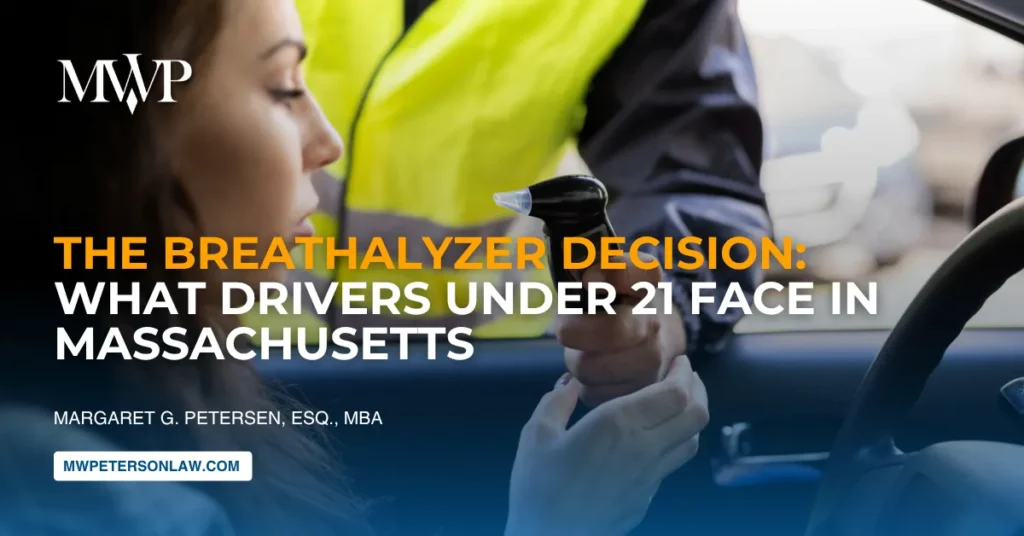
If you are under 21 and get stopped in Massachusetts on suspicion of operating under the influence (OUI), one of the first decisions you may face is whether to take a breathalyzer test. It feels like a split-second call, but the consequences can shape the next several years of your life. Here is what the law actually says.
Massachusetts Has a Zero-Tolerance Policy for Underage Drivers
When you drive in Massachusetts, you are considered to have already consented to a chemical test if you are arrested for OUI under M.G.L. c. 90, § 24. That is what the implied consent law means in practice. You are not physically forced to take the test, but refusing carries automatic administrative penalties that are entirely separate from anything that happens in your criminal case.
For drivers 21 and over, a BAC of .08% or higher is the threshold for a breathalyzer failure. For anyone under 21, the Registry of Motor Vehicles enforces a strict zero-tolerance standard and a BAC of .02% or higher is treated as a failure. That level can be reached with a single drink depending on body weight and timing. The passage of Melanie’s Law in 2005 significantly enhanced OUI penalties across the board in Massachusetts, and the rules for underage drivers are among the strictest in the state.
If You Take the Test and Fail
A BAC of .02% or higher triggers immediate consequences. For drivers ages 18 to 20, the administrative penalty is a 30-day license suspension plus an additional 180 days under the Juvenile Operator Law. For drivers under 18, it is a 30-day suspension plus an additional one year. In both cases, the additional suspension period can be waived by enrolling in the Youth Alcohol Program (YAP). YAP is typically required for reinstatement or hardship eligibility.
If your BAC registers at .08% or higher, the standard adult OUI penalties apply on top of the administrative ones, including potential fines of $500 to $5,000, up to 2.5 years of incarceration, and a one-year license suspension on conviction.
If You Refuse the Test
Refusal carries significantly steeper consequences than a failure, and the penalties for underage drivers are harsher than those for adults. Under M.G.L. c. 90, § 24, the suspension periods for refusing a chemical test are:
- First offense: 3-year suspension
- Second offense: 5-year suspension
- Third offense: Lifetime suspension
These suspensions are administrative, meaning they kick in immediately upon refusal regardless of what happens in the criminal case. A not guilty verdict or dismissal does not automatically lift them.
Suspensions Stack, They Do Not Overlap
This is the detail that catches most people off guard. All of these penalties run consecutively. The breathalyzer refusal or failure suspension must be completed before the Juvenile Operator Law suspension begins. Any suspension resulting from an OUI conviction starts only after those are finished. The total time without a license can add up quickly, especially for a young driver who still has school, work, and independence depending on it.
You Have the Right to Appeal, But the Window Is Short
For a breathalyzer refusal, you can request a hearing at the Boston (Haymarket) RMV within 15 days. The grounds for challenge are narrow: whether the officer had reasonable grounds to believe you were operating under the influence, whether you were placed under arrest, and whether you actually refused the test. If any one of those elements cannot be established, the suspension can be rescinded.
What This Means in Practice
For an underage driver who refuses the breathalyzer on a first offense, you are looking at a 3-year license suspension before anything else begins. Stack the Juvenile Operator Law suspension on top of that, and any conviction-related suspension after, and you can easily be without a license for four years or more from a single night.
Understanding these stakes before you are in the middle of a situation matters, and so does having someone in your corner who knows both the RMV process and the criminal side of these cases. With 15 years of combined legal experience, the Law Office of Matthew W. Peterson represents clients facing OUI and criminal charges.