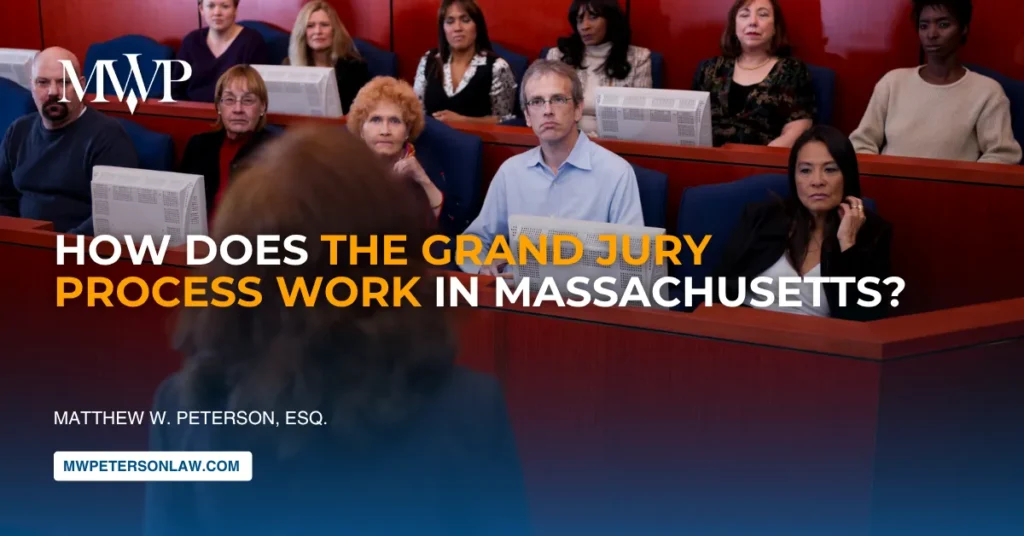
The Massachusetts grand jury process is the legal procedure used to determine whether there is enough evidence to formally charge someone with a serious felony by issuing an indictment. A grand jury does not decide guilt or innocence. Instead, it considers whether the Commonwealth has presented sufficient evidence to establish probable cause that a crime was committed and that the accused committed it.
In Massachusetts, a grand jury consists of up to 23 citizens who review evidence in secret, hear witness testimony, and decide whether to return an indictment. If you are under investigation or have recently learned that you have been indicted, understanding the grand jury process can help you make sense of what has already occurred behind closed doors and what to expect as your criminal case moves forward. This guide explains how the grand jury process works, who may testify, the role of the prosecutor, why the proceedings are confidential, and what happens after an indictment is returned.
How Grand Jurors Are Selected in Massachusetts
Grand jurors come from the same pool as trial jurors. The Office of Jury Commissioner draws names at random from a master list of residents in each judicial district. To qualify, a person must be at least 18, a U.S. citizen, a Massachusetts resident, able to understand English, and free of a disqualifying felony conviction.
From the people who are summoned, a Superior Court judge selects a panel of no more than 23 grand jurors, plus up to four alternates. The judge questions potential jurors about hardship and their ability to stay impartial over a long term of service. If a seated juror later cannot continue, the judge can swap in an alternate for hardship or other good cause. A full panel is 23, but the jury can still do its work with fewer members present.
How Long a Grand Jury Serves in Massachusetts
A grand jury serves for a term measured in months, not days. By rule, it keeps sitting until the next grand jury is impaneled to replace it, unless the court discharges it earlier or extends it to finish an investigation already underway. The statutory term varies by county. In the eastern Massachusetts counties where we practice, it generally runs four to six months.
Grand jurors usually report only part of the week during that stretch. That is a much larger commitment than the one-day-or-one-trial schedule most trial jurors follow, and it is part of why empaneling a grand jury can take a couple of days.
Who Is in the Room, and Who Is Not
Grand jury sessions are one-sided. An assistant district attorney presents the evidence, calls the witnesses, and questions them. The only people in the room are the grand jurors, the witness who is testifying at that moment, the prosecutor, and essential court staff such as a court reporter or an interpreter.
The accused is not there. Neither is defense counsel. A person under investigation has no right to attend, to testify, to call witnesses, or to cross-examine anyone. The evidence rules are also relaxed compared to a trial — the prosecutor can use hearsay and ask leading questions, and the bar to clear is probable cause, which is far lower than the proof beyond a reasonable doubt a trial demands. Grand jurors can ask their own questions of witnesses and can request things like fingerprints or DNA samples.
Secrecy, Recording, and Sealed Indictments
Grand jury proceedings are secret by law. The officials connected to the grand jury cannot disclose what happens inside, except in carrying out their duties or when a court directs them to. That secrecy serves real purposes: it encourages witnesses to speak freely, protects people who are investigated but never charged, and keeps a target from interfering with the case.
Secret does not mean unrecorded. Witness testimony is recorded, and so are the prosecutor’s questions and comments, and any legal instructions given to the jury. Proceedings are never supposed to go “off the record.” The one exception is the grand jury’s own deliberations and final vote, which are not recorded.
Sometimes a judge orders an indictment kept secret until after an arrest. This is a sealed indictment. The clerk seals it, and no one may reveal the charge except as needed to obtain and execute an arrest warrant. Prosecutors use this to keep a target from fleeing or destroying evidence before police can act. We cover sealed indictments in more detail in a separate post.
How the Vote Works: True Bill or No Bill
Once the evidence is in, the prosecutor asks the grand jurors to vote on each charge. For the jury to take any action, a quorum of at least 13 members must be present. To return an indictment, at least 12 grand jurors must agree there is probable cause. That number stays at 12 no matter how many people are in the room — whether 13 are present or the full 23.
The prosecutor does not stay for deliberations or the vote. The only exception is when the jurors themselves ask the prosecutor to come back in, and even then only to answer a question of law, never to comment on the facts. This rule keeps the grand jury independent instead of letting it become a rubber stamp.
If at least 12 jurors vote yes, the result is a true bill — an indictment. The foreperson signs it, and the case moves to Superior Court. If fewer than 12 agree, the result is a no bill, and no charge issues on that count. The grand jury reports its no-bill decisions back to the court.
What an Indictment Does and Doesn't Mean
An indictment is not a finding of guilt. It is a finding that there is probable cause to send the case forward. The standard is low, the proceeding is one-sided, and the defense never gets to respond inside the grand jury room. That is exactly why the first real chance to fight back often comes after the indictment — by challenging the sufficiency of the evidence the grand jury heard or the way the case was presented to it. An experienced defense attorney knows where those openings are.
Facing a Grand Jury Investigation in Eastern Massachusetts?
If you have learned that you are the target of a grand jury investigation, or you have already been indicted, talk to a lawyer before you talk to anyone else. Attorney Matthew Peterson is a seasoned Boston criminal defense attorney who defends people facing serious felony charges across eastern Massachusetts. The Law Office of Matthew W. Peterson offers free consultations for criminal matters — call or text 617-295-7500, or send us a message below. The sooner you have someone in your corner, the more options you have.