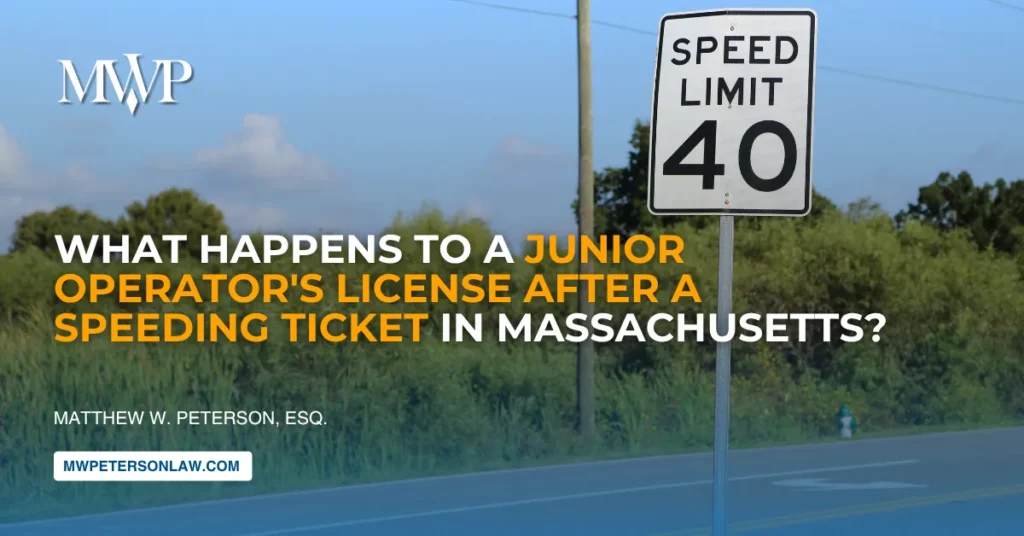
A first speeding ticket as a junior operator triggers an automatic 90-day license suspension, and a second or later offense triggers a full year. There is no fine-only option and no early way out. Massachusetts treats junior operator license speeding suspensions as mandatory, and the driver must serve the full period, even after turning 18. For a teenager who depends on driving for school, work, or family obligations, a single citation can sideline them for an entire season or longer.
How Long is a Junior Operator License Speeding Suspension?
Junior operators are drivers between 16½ and 18 who hold a Junior Operator’s License (JOL). Under the Junior Operator Law, the suspension periods for speeding are fixed:
- First offense: 90-day suspension
- Second offense: one-year suspension
- Third or subsequent offense: one-year suspension
These suspensions are mandatory by law. The Registry of Motor Vehicles has no discretion to shorten them, and they apply on top of the fine and the insurance surcharge that follow any speeding conviction. A teen who reaches 18 partway through the suspension still serves the rest of it.
The "No Hardship License" Warning Every Family Should Hear
This is the point that catches most families off guard: the RMV will not issue a junior operator a hardship license during a speeding suspension. An adult whose license is suspended after an OUI can often apply for a hardship license, sometimes called a “Cinderella license,” that permits limited driving for work, school, or medical care. The Registry does not extend that option to junior operators. There is no work exception, no school exception, and no medical exception available through the RMV. For a high school senior who drives to a job or to classes, that reality reshapes daily life for months.
There is one narrow avenue for relief, and families should understand its limits. A junior operator can appeal the suspension to the Board of Appeal of the Division of Insurance, a body independent of the RMV that has discretion to shorten a suspension or authorize a hardship license. That discretion is real, but it is used sparingly for junior operators.
The Board often treats these suspensions as a safety deterrent and is reluctant to grant relief to young drivers, so no family should assume an appeal will restore driving privileges. Whether an appeal is worth pursuing depends on the specific facts, and it is a decision better made with guidance than on optimism.
Paying The Ticket is The Same As Admitting The Violation
A speeding suspension follows a conviction, which in this context means being found responsible for the offense. Paying the citation is an admission of responsibility. For an adult, paying a speeding ticket often feels like the easy choice. For a junior operator, paying the ticket is what sets the 90-day suspension in motion.
A junior operator has the right to contest the citation at a clerk-magistrate hearing instead of paying it. Whether to contest depends on the facts, the radar or pacing evidence, and the realistic odds of a favorable result. There is no guaranteed outcome, but the decision to pay or to appeal carries far higher stakes for a junior operator than for an adult driver, because paying directly triggers the loss of the license. This is the moment where guidance matters most, and it comes before any suspension has started.
What It Takes To Get The license Back
Reinstatement after a junior operator license speeding suspension is not automatic once the clock runs out. The RMV requires the driver to:
- Pay a $500 reinstatement fee, plus a $50 surcharge
- Complete a Driver Attitudinal Retraining Course
- Complete the State Courts Against Road Rage (SCARR) program
- Pass the learner’s permit exam and the road test again
In other words, a junior operator who loses a license to speeding has to re-earn it much the way they earned it the first time. Building the time and cost of those steps into the picture helps families avoid a second surprise at the end of the suspension.
Parents and Guardians Are Notified Directly
When the RMV suspends a junior operator’s license for a Chapter 90 violation, the law requires the registrar to send notice of the suspension to the operator and, separately, to the parent or guardian, unless the junior operator is an emancipated minor. That notice goes out within 30 days after the disposition that triggered the suspension. Parents are not left to discover the problem on their own; the Commonwealth puts it in writing to them. For families, that notice is often the first prompt to ask whether anything can still be done.
How an Alcohol-Related Stop Turns a Setback Into a Crisis
A speeding suspension is serious, but it is the milder end of what a young driver can face. The contrast is worth understanding, because it shows how quickly a routine traffic stop can escalate into something far larger.
Massachusetts enforces a zero-tolerance rule for drivers under 21. A breath test reading of 0.02 or higher, which can mean less than a single drink, is treated as a failure. That failure brings an immediate 30-day suspension. On top of that, the RMV imposes a separate Youth Alcohol Program suspension that runs after the 30 days are finished. For a driver under 18, that added suspension is one year; for an 18-to-20-year-old, it is 180 days. Refusing the breath test is worse still, carrying a three-year suspension for an underage driver, plus the same Youth Alcohol Program suspension.
So a speeding ticket costs a junior operator 90 days. An alcohol-related stop can cost a year or more before any OUI charge in court is even resolved, and those alcohol suspensions are not erased by a not-guilty finding. A minor traffic error and an underage OUI are different worlds, and the gap between them is exactly why early, informed decisions matter so much for young drivers and their families.
Talk To A Lawyer Before You Decide How To Handle It
If your teen has been cited for speeding or, more seriously, stopped on suspicion of underage drinking and driving, the choices you make early can shape everything that follows. An experienced Boston criminal defense attorney can help you understand your options, protect your child’s rights, and work to safeguard a young driver’s record and license.
The Law Office of Matthew W. Peterson helps families throughout Eastern Massachusetts navigate underage OUI and other criminal charges. We offer free consultations for OUI and other criminal charges. Call or text 617-295-7500, or send us a message below, and we will walk you through where you stand and what you can do next.