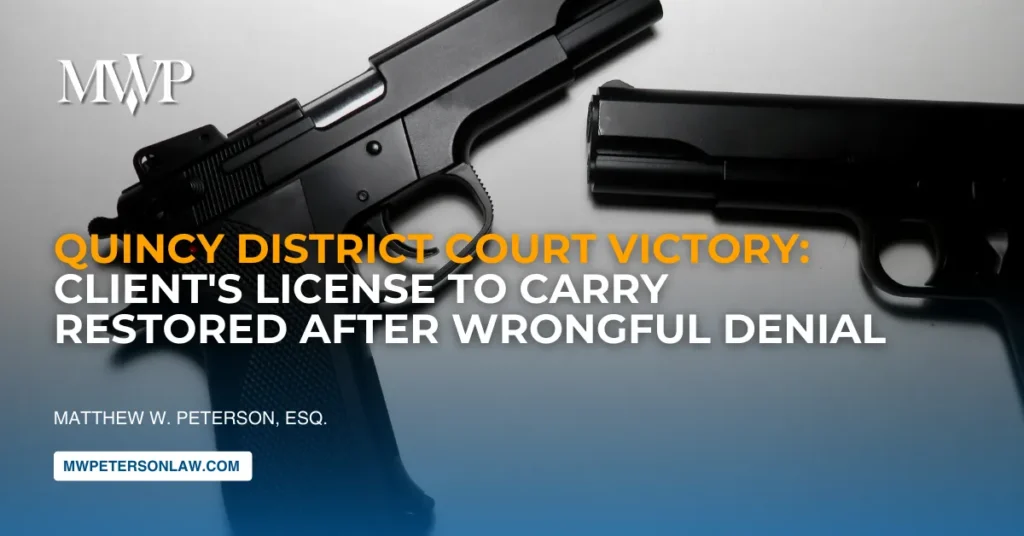
Getting denied a License to Carry in Massachusetts can feel devastating, especially when you know you’ve done nothing wrong. Our client recently experienced this frustration when his local police department denied his application based on two dismissed charges from over a decade ago. In December 2025, we achieved a Quincy District Court victory by successfully appealing that denial, and the judge ordered the police department to issue him a license.
Here’s how the process works and what we learned from this case.
How Massachusetts License to Carry Applications Work
Before you can legally possess or carry a firearm in Massachusetts, you need a License to Carry (LTC). The application process involves several steps. First, you must complete a state-approved firearms safety course. Then you submit your application to your local police department along with a $100 fee. The police will conduct a background check and schedule an interview with you.
During their review, the police examine two things. They look for statutory prohibitors, which are automatic disqualifications like felony convictions or active restraining orders. They also make a suitability determination, which is where things get complicated.
Suitability is a discretionary decision. The police can consider dismissed charges, charges that were never filed, and even conduct that was never charged at all. They can look at incidents that weren’t criminal in nature. This discretion gives police departments significant power over who receives a license.
For more details on the Massachusetts LTC application process, check out our other blogs on this topic.
Our Client's Situation
Our client had two incidents on his record from many years ago. Both resulted in criminal charges. Both charges were dismissed. Despite these dismissals, the police department denied his License to Carry application, finding him unsuitable based on these old cases.
He knew something wasn’t right. Dismissed charges should mean the court found insufficient evidence or the case was otherwise resolved in his favor. Why should they prevent him from exercising his Second Amendment rights over a decade later? Just because you walked into the courthouse doesn’t mean you’ll walk out. Several things can happen at an arraignment that result in you being taken into custody.
The Appeal Process
When our client received his denial, he hired us to file an appeal. Under Massachusetts law, you have 90 days from receiving your denial to file a petition for judicial review in district court. This deadline is absolute. If you miss it, you lose your right to appeal.
We filed the appeal in Quincy District Court and received a hearing before a judge. The police department presented their case, calling witnesses to testify about the dismissed charges. However, both witnesses were officers from the same police department that denied the application. Neither witness had any firsthand knowledge of the underlying incidents.
Our Legal Arguments
We challenged the evidence on multiple grounds. The police department was relying entirely on hearsay, and not just simple hearsay, but multilayered hearsay from sources with no direct knowledge of what actually happened in those old cases.
Even in administrative hearings like license appeals, the police must rely on reliable hearsay. They cannot base their decisions on rank hearsay or information passed through multiple sources without any connection to the original events. We argued there was no admissible, reliable evidence to support the denial.
We also argued that the denial was arbitrary and capricious. Our client has been a hardworking father with no criminal history in the past 15 years. The police department offered no evidence about his current character, his community standing, or any reason to believe he posed a safety risk today.
The Result
After hearing both sides, the judge agreed with our arguments. The court found no reasonable ground for denying our client’s license and ordered the police department to issue him a License to Carry.
What This Means for You
If you’ve been denied a License to Carry, time is critical. You have only 90 days to appeal, and once that window closes, you have no recourse. The appeal must be filed within that period.
License to Carry appeals involve legal technicalities that can make or break your case. It’s not enough to simply be a good person or to argue that you deserve a license. You need to understand the evidentiary standards, know how to challenge unreliable evidence, and present your case effectively to a judge.
We have successfully represented people across Eastern Massachusetts who were wrongfully denied their Second Amendment rights. If you’ve received a denial letter, don’t wait. Contact the Law Office of Matthew W. Peterson at 617-295-7500 to set up a strategy session today. We represent clients throughout Southern Massachusetts and can help you understand your options before you set foot in that courtroom.