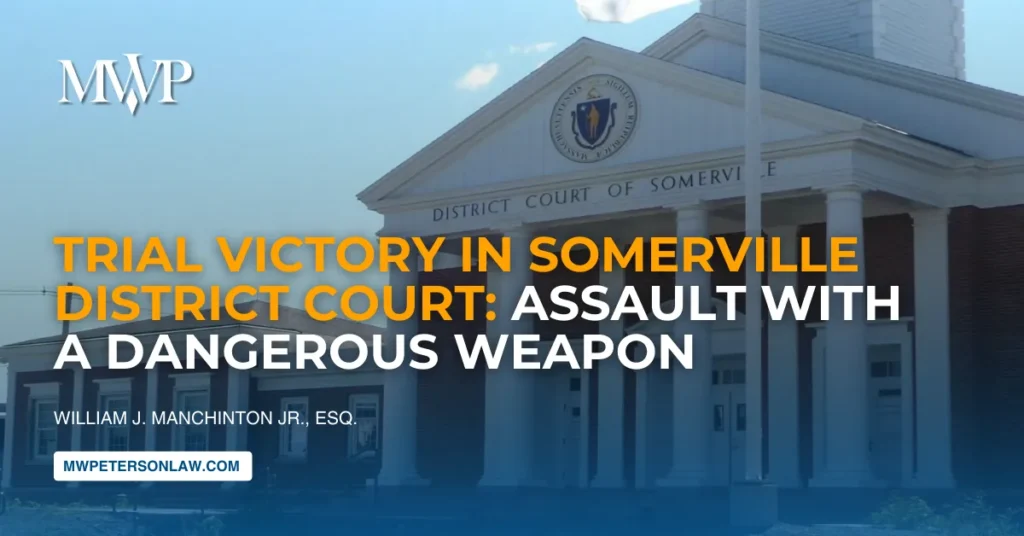
We recently obtained a not guilty verdict in Somerville District Court on a charge of assault with a dangerous weapon. Our client, a college student with no prior criminal record, was accused of chasing her ex-boyfriend down the street with a knife. She maintained from the beginning that the allegation was fabricated.
The case had no physical evidence. No knife was ever recovered. No photographs documented any weapon. No surveillance video captured what allegedly happened. The entire prosecution rested on the testimony of the complainant.
Preparation Makes the Difference
Before trial, we reviewed every piece of discovery available. We studied the complainant’s prior statements line by line and compared them against police reports and other records. Critically, we spent significant time with maps and satellite imagery of the location where this incident supposedly occurred.
The complainant had given a specific account of where he was standing, where our client allegedly approached from, and how the confrontation unfolded. He had committed to these details in his written statement and in conversations with investigators. Our job was to test whether those details held together.
Cross-Examination Using the Map
During cross-examination, Attorney William Manchinton Jr. asked the complainant to walk through exactly what happened using a map of the area.
- Where were you standing?
- Where did you first see the defendant?
- Which direction did she come from?
With each question, he confirmed the geography of his version of events.
Then we walked him through the physical layout of the space. The buildings, the sight lines, the distances involved. And piece by piece, it became clear that his story simply didn’t add up. The complainant tried to adjust, hedging on details he had been certain about moments before. But it was too late. He had already committed to his version of events, and the map showed it couldn’t have happened the way he said it did.
The Value of Thorough Preparation
Cross-examination works best when it is methodical rather than confrontational. The goal is to lock a witness into their account, confirm every detail, and then demonstrate that those details are inconsistent with the physical evidence or with common sense. Maps, photographs, and diagrams are particularly effective tools for this purpose.
A witness can tell a compelling story in narrative form, but when forced to anchor that story to physical reality, inconsistencies become apparent. In this case, the judge saw a complainant whose account did not hold together under scrutiny and a young woman facing serious charges with no physical evidence against her. The court returned a verdict of not guilty.
Conclusion
If you are facing criminal charges, the prosecution’s case often looks stronger on paper than it does when tested at trial. Witness accounts that sound convincing in a police report can fall apart when examined against physical evidence and basic logic. The difference between a conviction and an acquittal often comes down to preparation, finding the weaknesses in the case before trial, and knowing how to expose them effectively.
Our client walked out of Somerville District Court with her future intact because we took the time to prepare thoroughly and focused our cross-examination on demonstrating that the complainant’s story did not make sense. To discuss your case and your options, contact us now to set up a strategy session by calling 617-295-7500.