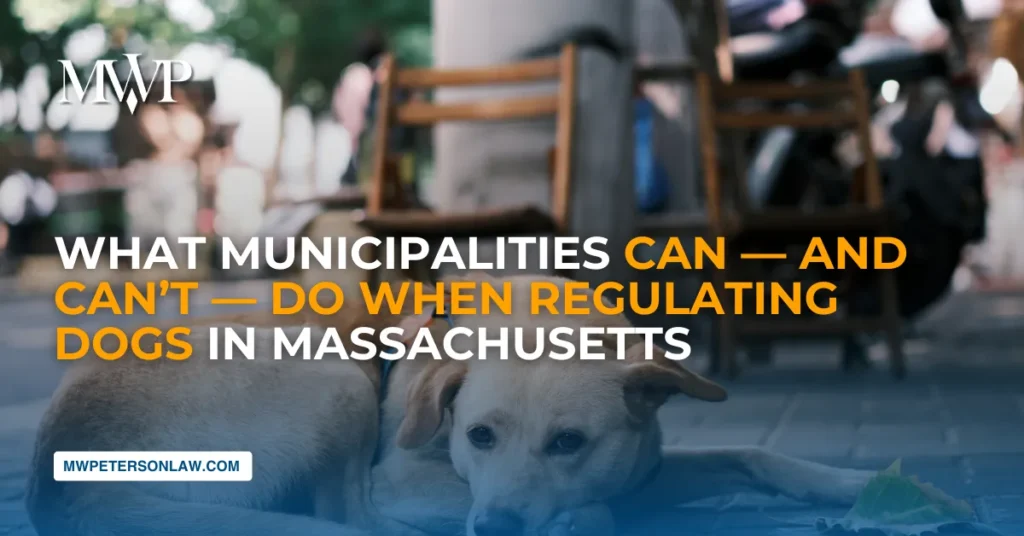
Cities and towns in Massachusetts hold important responsibilities when it comes to protecting the public from dangerous or nuisance dogs. But their authority is not unlimited. Massachusetts statutes and court decisions define precisely what steps municipalities are allowed, and forbidden, to take when regulating dogs.
Cases such as American Dog Owners Association v. City of Lynn, Viner v. Town of Northborough, and Creatini v. McHugh, together with Massachusetts General Laws Chapter 140, Section 157, establish the framework for these powers and their limits.
Municipal Authority Under Massachusetts Law
Under G.L. c. 140, § 157, anyone may file a written complaint with their local “hearing authority” alleging that a dog is either a nuisance or dangerous. The statute requires the city or town to investigate, hold a public hearing, and decide based on evidence and testimony.
If a dog is deemed a nuisance, the municipality may order the owner to take corrective measures. If the dog is found to be dangerous, the law allows for stronger actions, including humane restraint, secure confinement, mandatory muzzling when off-premises, or even euthanasia in extreme cases.
Section 157 also empowers municipalities to require owners of dangerous dogs to carry insurance and to provide identifying information such as microchips or veterinary records. But the statute contains two key restrictions:
“No order shall be issued directing that a dog deemed dangerous shall be removed from the town or city in which the owner of the dog resides. No city or town shall regulate dogs in a manner that is specific to breed.”
In short, Massachusetts law does not permit the exile of individual dogs from their owner’s town of residence but allows local governments to regulate dogs based on behavior (though importantly, not breed).
Breed-Specific Bans Are Prohibited
This restriction stems directly from American Dog Owners Association, Inc. v. City of Lynn (1989). In that case, the Supreme Judicial Court invalidated several Lynn ordinances attempting to ban or restrict ownership of pit bulls. The Court found that the ordinances were “unconstitutionally vague,” noting that there was “no scientific means, by blood, enzyme, or otherwise, to determine if a dog is a particular breed or any mixture thereof.”
The Court also criticized the city’s reliance on “conflicting, subjective standards” by dog officers, which created arbitrary enforcement. The decision effectively established that Massachusetts municipalities cannot enact laws targeting specific breeds, a principle later codified in the 2012 amendment to § 157.
Municipal Hearings in Practice: The Northborough Example
In Viner v. Town of Northborough (2016), the town’s Board of Selectmen held a hearing under § 157 after years of complaints about three Airedale terriers that had repeatedly attacked neighbors and their dogs. Following testimony and evidence, the Board declared the dogs a nuisance and ordered the owners to install an eight-foot fence, muzzle one dog at all times, and maintain regular inspections of the enclosure.
When the owners appealed, the District Court conducted a de novo hearing, meaning it reviewed the case from scratch (different from some other appeal proceedings) and upheld the order. The Appeals Court further affirmed that the town acted properly under § 157, finding that the Board’s measures were reasonable responses to the dogs’ behavior and within its legal authority.
Landowners and Municipal Liability
Municipalities and property owners are not automatically responsible for dogs they do not own or control. In Creatini v. McHugh (2021), a bicyclist sued the landlord after being injured when a tenant’s dog attacked another dog, claiming the landlord should have prevented the incident. The Appeals Court rejected the argument, holding that the landlord had no legal duty to protect passersby from a tenant’s dog and emphasizing that “reasonable persons would not recognize such a duty.”
The Court concluded that public policy in Massachusetts “places responsibility for dogs, including pit bulls, on the owners and keepers of those dogs—not on third-party landowners.”
If Your City or Town Has Taken Action Against You or Your Dog
If your city or town has labeled your dog a “nuisance” or “dangerous” and imposed conditions, fines, or restrictions, you have rights under Massachusetts law. Section 157 allows owners to appeal the local order to the District Court and request a full hearing. You can present evidence, call witnesses, and challenge the municipality’s findings.
These proceedings can be complicated and emotionally difficult. Having an attorney who understands the nuances of animal law and municipal authority can make all the difference. A skilled lawyer can help ensure your dog is treated fairly, your due process rights are respected, and any restrictions are lawful and proportionate.
At the Law Office of Matthew W. Peterson, we represent Massachusetts dog owners in disputes with cities and towns, from local hearings to court appeals, with deep and diverse courtroom experience, compassion, and a commitment to justice.
Learn what Massachusetts cities and towns can legally do, and cannot do, when regulating dogs under G.L. c. 140, § 157. Understand your rights if your dog has been labeled “dangerous” or “nuisance,” and how the Law Office of Matthew W. Peterson can help defend them.
Frequently Asked Questions (FAQ)
Q: What is the difference between a “nuisance” dog and a “dangerous” dog in Massachusetts?
A: Under G.L. c. 140, § 157, a “nuisance” dog is one that, for example, habitually barks or causes minor disturbances, while a “dangerous” dog is one that has attacked, attempted to attack, or seriously threatened a person or another animal. The label matters because “dangerous” findings allow the city or town to impose much stricter conditions on the owner.
Q: Who can file a complaint about my dog, and what happens after a complaint is filed?
A: Anyone can file a written complaint with the local hearing authority (such as the select board or a designated officer) claiming that a dog is a nuisance or dangerous. The municipality must then investigate, schedule a public hearing, and decide based on evidence and testimony whether your dog is a nuisance or dangerous and what, if any, conditions to impose.
Q: What kinds of restrictions can my city or town put on my dog if it is found “dangerous”?
A: If a dog is deemed dangerous, the municipality can order secure confinement, require humane restraint, mandate muzzling when off the owner’s property, and in extreme cases order euthanasia. They can also require things like proof of insurance, microchipping, and updated veterinary records. Any conditions must be tied to the dog’s behavior and be reasonably related to public safety.
Q: Can my town force me to get rid of my dog or ban my dog’s breed (like pit bulls)?
A: No. Massachusetts law specifically prohibits orders that require a dangerous dog to be removed from the town, and it forbids breed-specific regulation. Cities and towns cannot legally ban or target particular breeds such as pit bulls; they must regulate based on behavior, not breed.
Q: Can a landlord or property owner be held responsible for a tenant’s dog?
A: In most cases, no. Massachusetts courts have held that landlords generally do not have a legal duty to protect members of the public from a tenant’s dog, unless the landlord is actually an “owner” or “keeper” of the dog or exercises direct control over it. Responsibility usually rests with the dog’s owners or keepers, not third-party landowners.
Q: When should I contact an attorney about a dangerous or nuisance dog case?
A: You should talk to an attorney as soon as you receive notice of a complaint, a hearing, or an order against you or your dog. These proceedings move quickly, and the outcome can affect your dog’s future and your own liability. An attorney who understands Massachusetts animal law and municipal powers can help you prepare for the hearing or appeal, challenge improper conditions, and work toward a result that protects both your rights and your dog.