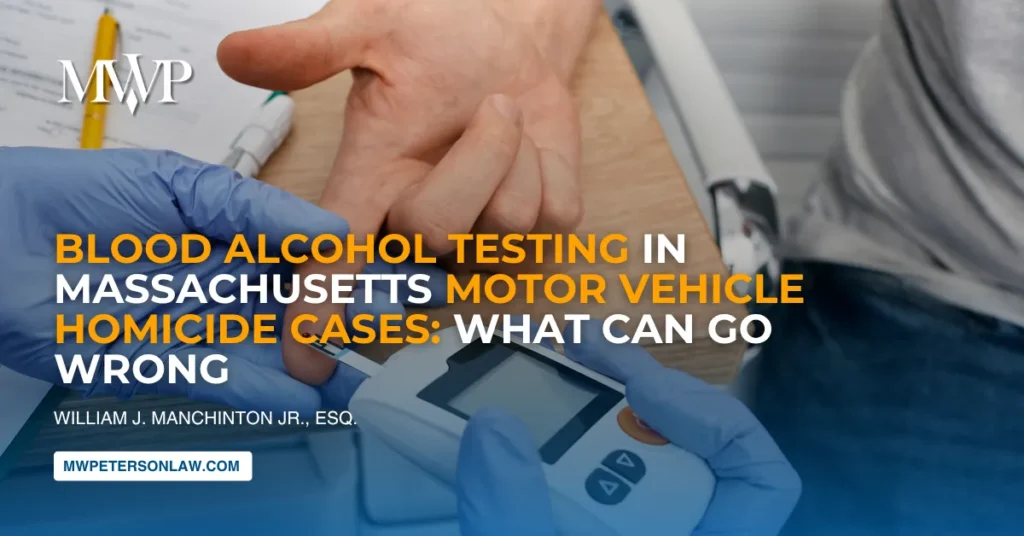
Blood alcohol testing often plays a central role in Massachusetts motor vehicle homicide OUI cases, but a blood alcohol concentration (BAC) result is not automatically conclusive evidence of guilt. When the Commonwealth charges someone with motor vehicle homicide while operating under the influence under M.G.L. c. 90, § 24G, prosecutors frequently rely on blood test results to prove impairment. However, every BAC result depends on a chain of equipment, collection procedures, laboratory analysis, timing, and human judgment—and problems at any stage can affect the reliability of the evidence.
A strong defense does not accept blood alcohol testing results at face value. Instead, it examines how the blood sample was collected, stored, transported, and analyzed, whether proper testing protocols were followed, and whether the reported BAC accurately reflects impairment at the time of the crash. This guide explains how blood alcohol testing works in Massachusetts, common challenges to BAC evidence, and why test results are only one part of the Commonwealth’s case.
Hospital Blood Draws and Police Breathalyzers Are Not the Same Thing
In a fatal crash, your BAC usually comes from one of two sources, and they fail in different ways.
The first is the police breathalyzer, the Draeger Alcotest 9510. For years, breath test results were excluded statewide because of the Office of Alcohol Testing’s failures in the Commonwealth v. Ananias litigation, though serious injury and death cases were treated as an exception even then. Breath tests are admissible again for machines calibrated and certified on or after April 18, 2019, but “admissible” is not the same as “accurate.” The machine still has to be operated correctly, calibrated properly, and supported by the records the Commonwealth is required to produce at trial.
The second source is a hospital blood draw, common when a driver is taken to the emergency room after a serious accident. Hospital blood is drawn for treatment, not for court. Hospitals often run fast enzymatic screening tests that measure serum or plasma rather than whole blood, and serum readings run meaningfully higher than whole blood. The State Police crime laboratory, by contrast, uses gas chromatography on whole blood under the protocols in 501 CMR 2.00. The gap between a hospital screening number and a forensic whole-blood result is real, and it matters.
Consent matters too. Under Massachusetts law, a police-directed blood draw or analysis requires your actual consent, and as the SJC held in Commonwealth v. Bohigian, even a search warrant will not override a refusal. That protection reaches beyond simple OUI: Bohigian itself was a serious-injury case, and Commonwealth v. Moreau extended the consent requirement to blood that hospital staff drew but the government later analyzed.
The important recent wrinkle is Commonwealth v. Gannett (2025): the SJC held that when a State lab scientist simply converts a serum ethanol figure already recorded in your hospital medical records into a whole-blood BAC, that mathematical conversion is not a “chemical test or analysis” requiring consent. In other words, refusing the police test does not always keep a hospital-derived number out of evidence, which is exactly why attacking the reliability of that number matters so much.
The Timing Problem: Retrograde Extrapolation and Rising BAC
Your BAC at the moment blood is drawn is not your BAC at the moment of the crash, and in a fatal-accident investigation, hours often pass before a sample is taken. To bridge that gap, the prosecution relies on retrograde extrapolation: a calculation that works backward to estimate what your BAC “must have been” earlier. That calculation is only as good as its assumptions about your absorption rate, elimination rate, when you last drank, and whether you ate.
This opens the door to a rising-BAC defense. Alcohol takes time to absorb. If you were still in the absorption phase when the crash occurred, your BAC at that moment may have been lower than the later test showed, potentially below the legal threshold. The same number the Commonwealth uses to prove impairment can, with the right expert, point the other way.
Chain of Custody: Every Hand the Sample Passed Through
A blood sample is only as reliable as its handling. From the draw to the lab bench, the Commonwealth must document who drew the blood, how the vial was labeled and sealed, how it was stored and refrigerated, who transported it, and who tested it.
Gaps anywhere in that record are fair game. Improperly preserved samples (for example, ones lacking adequate preservative) can ferment and generate alcohol after collection, inflating the result. An alcohol-based swab used at the draw site can contaminate the sample. Each break in the chain is a place to challenge whether the number means anything at all.
Breathalyzers Are Not Purely Ethanol-Specific
The breath machine does not detect ethanol alone. Its infrared sensor responds to a class of molecular structures, which is why substances like acetone (elevated in diabetics and in people on low-carbohydrate diets) have been documented to produce false or inflated readings. Mouth alcohol from acid reflux, dentures, or regurgitation can do the same.
This is why the observation period exists. Under 501 CMR 2.14, the operator must continuously observe the subject for a full fifteen minutes before the test to confirm nothing enters the mouth that could contaminate the sample. When the officer looks away, turns to paperwork, or the subject belches or vomits during that window, the foundation for the result is compromised, and a motion challenging admissibility becomes a serious option.
How a Defense Toxicologist Takes the Case Apart
This is where an independent toxicology expert earns their keep. A defense toxicologist reviews the calibration and certification records (now available through OAT’s online portal), the maintenance history, the breath profile data, the serum-to-whole-blood conversion math, and the extrapolation assumptions.
They can quantify the measurement uncertainty the OAT itself acknowledges and explain, in front of a jury, why the reported number is not the precise fact the Commonwealth presents it as, and why a defensible range may fall below the line that decides the case.
Talk to a Lawyer Who Knows How BAC Evidence Fails
In a § 24G case, the difference between a conviction and an acquittal often lies in the testing details most people never think to question. If you or someone you love is facing motor vehicle homicide or OUI charges in Eastern Massachusetts, where BAC evidence is central, contact the Law Office of Matthew Peterson today at 617-295-7500, or send us a message below for a free consultation.