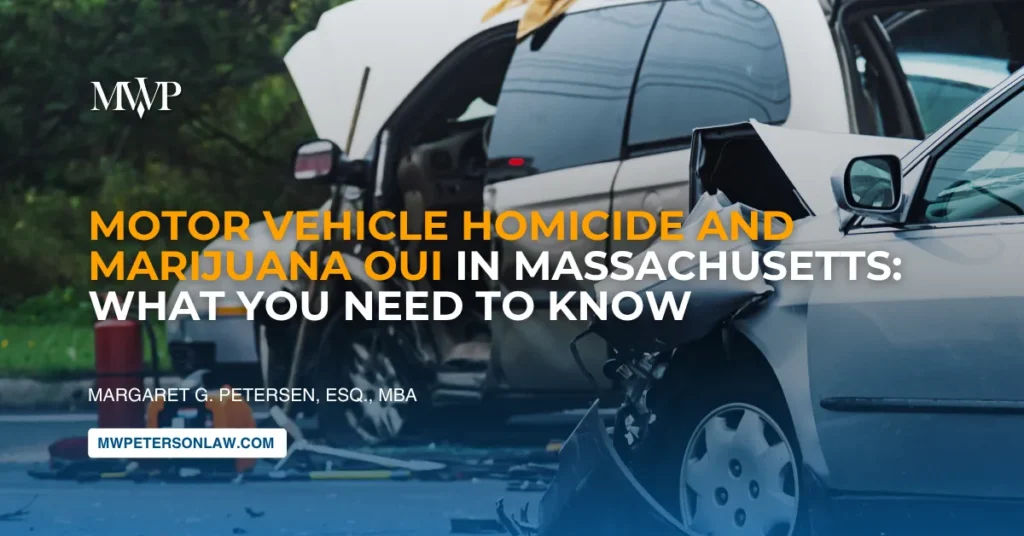
Motor Vehicle Homicide and Marijuana OUI cases are fundamentally different from alcohol-related OUI cases because there is no legal THC limit that automatically proves impairment. Instead, the Commonwealth must rely on evidence such as driving behavior, police observations, field sobriety tests, witness testimony, toxicology results, and expert opinions to establish that a driver was impaired at the time of the crash.
Although Massachusetts legalized recreational marijuana in 2016, legalization did not change the prohibition against driving while impaired by marijuana or other drugs. If you are facing a motor vehicle homicide charge involving marijuana, cannabis, or prescription medications, understanding how prosecutors attempt to prove drug impairment is critical.
This guide explains Motor Vehicle Homicide and Marijuana OUI, the evidence commonly used in these cases, the challenges of proving THC impairment, the role of toxicology and expert witnesses, and the legal defenses that may be available under Massachusetts law.
Is There a Legal THC Limit for Marijuana OUI in Massachusetts?
When it comes to alcohol, Massachusetts law sets a clear threshold: a blood alcohol concentration of .08 or higher creates a legal presumption of impairment. There is no equivalent rule for marijuana or other drugs.
What is the difference between alcohol and marijuana OUI laws?
Prosecutors cannot simply point to a THC level in your blood and say you were legally impaired. They actually have to prove impairment through other evidence, and that burden is harder to meet than many people realize. This is one of the most important distinctions in marijuana OUI cases, and it opens meaningful avenues for defense.
Why is Blood Testing Unreliable in Marijuana OUI Cases?
Here is the scientific reality that makes marijuana OUI cases fundamentally different from alcohol cases: THC metabolites linger in your bloodstream for days or even weeks after use, long after any actual impairment has passed.
How long do THC metabolites stay in your system?
A person who used marijuana three days before getting behind the wheel might test positive for THC metabolites. That positive result does not mean they were impaired at the time of the crash. It means they used marijuana at some point recently. Blood testing simply cannot tell us when someone last felt the effects of the drug, which is the question that actually matters.
What can defense attorneys challenge about blood tests in marijuana cases?
Defense attorneys in these cases scrutinize the timing and method of blood draws, the specific metabolites tested, and whether the laboratory followed proper protocols. These are not minor technical arguments. They go to the heart of what the prosecution can and cannot prove.
What are Drug Recognition Experts and Can Their Testimony Be Challenged?
Because blood tests are so unreliable for establishing marijuana impairment, prosecutors often turn to testimony from Drug Recognition Experts, commonly called DREs. These are law enforcement officers trained in a specific 12-step evaluation protocol designed to identify drug impairment.
What is the 12-step DRE protocol?
The DRE protocol is a standardized evaluation that officers use to assess whether a driver is impaired by drugs rather than alcohol. It includes physical tests, eye examinations, and interviews.
Why is DRE testimony questionable in court?
The problem is that DRE testimony is far from infallible. The underlying science has been questioned by researchers, and the protocol itself depends heavily on the officer’s subjective observations and judgment calls. Defense attorneys can challenge DRE testimony by examining the officer’s training record, whether the evaluation was conducted correctly, and the peer-reviewed literature casting doubt on the reliability of DRE assessments.
Courts in Massachusetts have admitted DRE testimony, but that does not mean a jury has to accept it uncritically. A skilled defense attorney will work to expose its limitations.
Can You Be Charged With OUI for Taking Prescription Drugs as Directed?
Marijuana is not the only drug that complicates OUI cases. Prescription medications, including sleep aids like Ambien and opioid pain medications, present similar challenges for prosecutors and similar opportunities for the defense.
Which prescription drugs commonly lead to OUI charges?
Someone who took a prescribed dose of a medication as directed by their doctor may still face an OUI-drugs charge if law enforcement concludes they were impaired.
How does therapeutic use affect a prescription drug OUI case?
These cases require careful examination of the dosage, the prescribing circumstances, and whether the level of the drug in the person’s system was consistent with therapeutic use or something more.
How Do Prosecutors Prove Marijuana Impairment in Motor Vehicle Homicide Cases?
When blood testing is unreliable and DRE testimony is contestable, prosecutors often piece together a case using a combination of evidence.
What evidence do prosecutors use when blood tests are unreliable?
- Witness statements about driving behavior before the crash
- The observations of first responders at the scene
- Any statements made by the driver
- Physical evidence like paraphernalia in the vehicle
- The DRE evaluation
Can each piece of evidence be challenged individually?
Each piece of that puzzle can be challenged individually and as a whole. The absence of a clean scientific threshold for impairment is genuinely significant, and it is something an experienced defense attorney can work with.
Should You Hire a Massachusetts Criminal Defense Attorney?
A motor vehicle homicide charge involving marijuana or prescription drugs is serious, and the stakes are high. But so is the burden the prosecution must meet. If you or someone you love is facing this charge, an experienced Boston criminal defense attorney can evaluate the scientific and legal issues unique to drug OUI cases. The details matter enormously, and an early, thorough review of the evidence can shape the direction of the entire case.
If you or a family member is facing a motor vehicle homicide charge in Massachusetts, the Law Office of Matthew W. Peterson offers free consultations for criminal charges. We understand the science behind drug testing, the limitations of Drug Recognition Expert (DRE) testimony, and how to build a defense that addresses both the legal and human dimensions of your case. Call or text 617-295-7500, or send us a message below, and we will help you understand where you stand and what comes next.