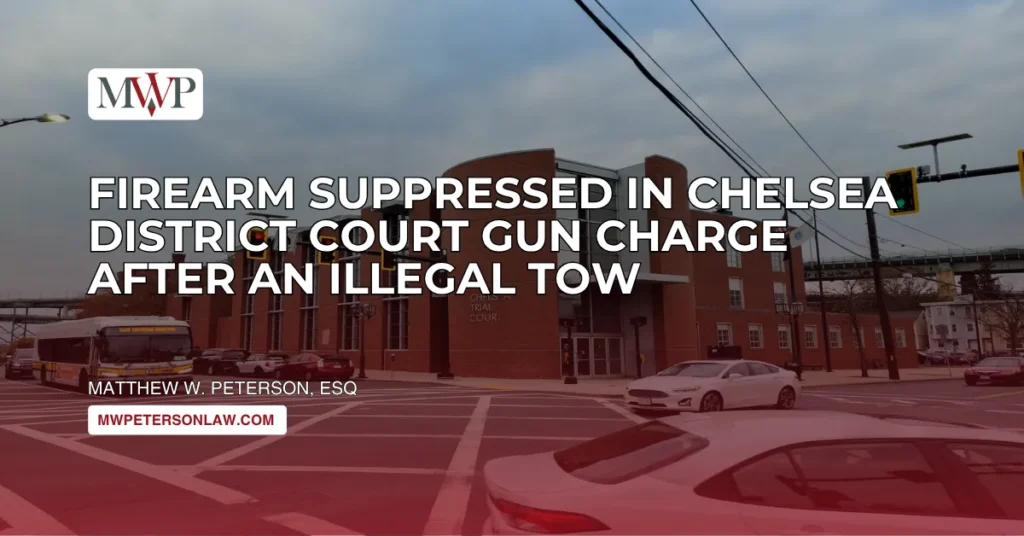
Attorney Matthew Peterson won a motion to suppress in a Chelsea District Court firearm suppressed, and the judge threw out the firearm a state trooper found while searching his client’s car. The ruling followed a three-day evidentiary hearing. The client had been facing a mandatory minimum jail sentence.
The case turned on something most people never think about: whether the trooper had any business towing the car in the first place.
A Traffic Stop on Revere Beach
A trooper pulled the client over on Revere Beach Boulevard. The reason was a suspended registration. The Registry had suspended it the day before over unpaid tickets.
The client did not know. That happens constantly. Registry suspensions for unpaid tickets take effect automatically after a mailed notice, and plenty of drivers find out only when blue lights appear behind them.
The car came to rest legally parked at the curb. It blocked no traffic and created no hazard.
The trooper decided to tow it anyway. He never asked the client whether someone with a valid license could come get it. He never raised the option of leaving it where it sat. Before the tow truck arrived, he searched the car and found a firearm.
Why the Tow Decided the Case
Police cannot search a car just because they are towing it. The tow itself has to be justified first.
Massachusetts courts treat an inventory search as an administrative task, not an investigation. It exists to protect the owner’s property, protect police and tow companies from false claims, and keep dangerous items off the street. Because it serves those limited purposes, two things have to hold up. The decision to impound the car must be reasonably necessary under the circumstances. And the search itself must follow the department’s written policy.
The burden sits with the prosecution on both points. It is not the driver’s job to prove the tow was unnecessary.
That is where this case came apart. The State Police have a written inventory policy, and it contemplates situations where no tow and no inventory should happen at all — including when a vehicle is legally parked and secured, or when a third party takes it. The trooper never engaged with those options. He never gave the client the chance to raise them.
Attorney Peterson built the hearing around that gap. Over three days, the testimony showed a trooper who had settled on towing before he considered whether towing was necessary, and who bypassed the policy that was supposed to constrain that choice. The judge allowed the motion and suppressed the firearm.
The Profiling Claim the Court Did Not Need to Reach
The defense raised a second challenge. The client is Hispanic, and Attorney Peterson developed evidence of a disparity in how officers stopped Hispanic drivers.
Massachusetts law allows this argument. A driver who points to specific facts supporting a reasonable inference that a stop was motivated by race shifts the burden to the prosecution, which then has to do more than say a traffic violation occurred. No statistics are required, though they can help.
The judge never reached it. Once the inventory search failed, the firearm was out regardless, and there was no need to decide the profiling question. The claim was preserved and argued, but the ruling rests on the tow.
If Police Towed Your Car and Found Something
A few things are worth knowing.
The tow is a separate legal question from the search, and it is often the weaker link. Ask what the department’s written policy actually says, because the policy is frequently more restrictive than the officer’s conduct. Body camera and cruiser footage matters enormously here, since it captures whether the officer ever considered another option. And a registration or license problem you did not know about is still worth fighting, because how police responded to it can decide the whole case.
None of this is automatic. Courts do not require officers to offer alternatives in every situation, and a car that cannot be secured is a different case entirely. Outcomes depend on the specific facts, the specific policy, and the record built at the hearing.
If you are facing a gun charge or another criminal charge in eastern Massachusetts, the firm offers free consultations. Call or text 617-295-7500, or send us a message below.