
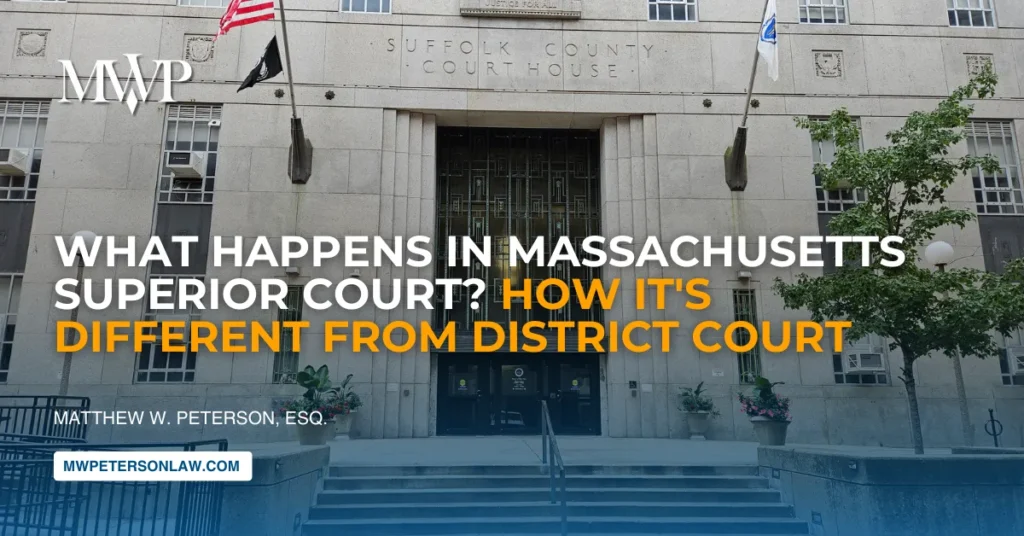
The Massachusetts Superior Court handles the most serious criminal cases in the Commonwealth. Unlike the District Court, which is limited to sentences of up to two and a half years in the House of Correction, the Superior Court has the power to sentence defendants to state prison for years, decades, or even life.
Cases reach the Superior Court through a grand jury indictment, and defendants face twelve-person juries instead of the six-person juries used in District Court. If your case has been moved to Superior Court, the stakes are significantly higher—and understanding how this court works is the first step toward protecting yourself.
How Cases Get to Massachusetts Superior Court
Most criminal cases in Massachusetts start in District Court. That’s true even for very serious charges—someone arrested for murder will still be arraigned in District Court before the case moves up. The key difference is *how* cases reach the Superior Court. The prosecution must present evidence to a grand jury and obtain an indictment. A grand jury only hears the government’s side of the story, so an indictment is not a finding of guilt. It simply means the grand jury found enough probable cause to move forward with formal charges.
Some charges carry what’s called “exclusive original jurisdiction,” meaning they can only be tried in Superior Court. First-degree murder is the most well-known example. For many other felonies, the District Court and Superior Court share “concurrent jurisdiction” under G.L. c. 218, § 26, and the prosecutor decides which court to pursue the case in. That decision often depends on the severity of the alleged conduct, the defendant’s criminal history, and the sentence the prosecution wants to seek.
The Key Differences That Matter
Sentencing Power
This is the biggest distinction. A District Court judge can sentence a defendant to a maximum of 2 and a half years in the House of Correction for a single offense. A Superior Court judge can sentence a defendant to state prison for any length of time the law allows, including life in prison for the most serious felonies. That gap in sentencing authority is the reason serious cases are prosecuted in Superior Court.
Jury Size
In the District Court, a criminal jury consists of six people. In Superior Court, you get a full twelve-person jury. A larger jury means the prosecution must convince more people of guilt beyond a reasonable doubt, which can work in a defendant’s favor during deliberations.
Case Volume and Pace
District Courts handle a much higher volume of cases. Pretrial sessions can involve hundreds of matters called in a single week. Superior Court carries fewer cases but dedicates more time and resources to each one. The pretrial process in Superior Court tends to be more thorough, with more extensive discovery, motion practice, and preparation on both sides.
What to Expect If Your Case Is in Superior Court
After a grand jury returns an indictment, you’ll be arraigned in Superior Court. The judge will address bail—and in serious cases, the Commonwealth may request a dangerousness hearing under G.L. c. 276, § 58A, which can result in pretrial detention for up to 120 days.
From there, your attorney will begin reviewing discovery, filing pretrial motions, and building your defense. Motions to suppress evidence, motions to dismiss, and other pretrial challenges can have a dramatic impact on the outcome of a Superior Court case. This stage of the case is often where the most important work happens.
If your case goes to trial, you’ll face that twelve-person jury. The Commonwealth must prove every element of the charge beyond a reasonable doubt, and the verdict must be unanimous.
Why Experienced Representation Matters
Superior Court criminal practice is a different arena from District Court. The sentences are longer, the legal issues are more complex, and the prosecution is typically bringing its strongest resources to bear. Having an attorney who understands Superior Court procedure, knows how to challenge a grand jury indictment, and has real trial experience at this level can make the difference between a conviction and a favorable outcome.
If you or a loved one is facing serious criminal charges in Eastern Massachusetts, you need an experienced Boston criminal defense attorney who is ready for trial. The Law Office of Matthew W. Peterson has skilled Suffolk County trial lawyers who have successfully handled numerous jury trials and Superior Court cases. Call 617-391-0060 today to discuss your defense.
Disclaimer: This information is for educational purposes and is not legal advice. If you need legal advice, contact a qualified attorney.