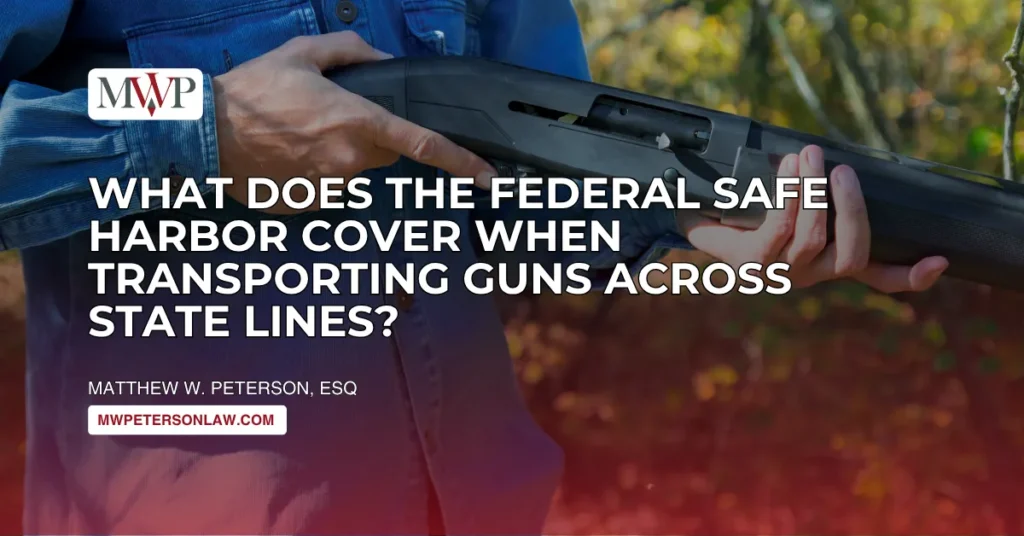
The federal safe harbor covers you only while you are actually moving a gun from one place where you may lawfully have it to another place where you may lawfully have it. Transporting guns across state lines is protected under this rule when the firearm is unloaded and neither the gun nor the ammunition is within reach of the passenger compartment. That is the whole of it. The protection is narrower than most gun owners assume, courts read it narrowly, and it does not stop an officer from putting you in handcuffs.
Gun owners call this rule Section 926A, or the safe passage provision of the Firearm Owners’ Protection Act. It was written in 1986 and has not changed since.
What The Federal Safe Harbor Requires
Five things have to be true at once.
- You cannot be federally barred from having a gun. A disqualifying conviction, restraining order, or immigration status takes you outside the rule entirely.
- Both ends of the trip have to be lawful for you personally. Not lawful in general — lawful for you. If your destination bans the gun you are carrying, or requires a permit you do not hold, the protection never attaches.
- You have to be traveling for a lawful purpose: hunting, a competition, a training class, a move, a visit home.
- The gun has to be unloaded. Magazine out, chamber clear.
- The gun and the ammunition both have to be out of reach, meaning not readily accessible or directly accessible from the passenger compartment. In a car with a trunk, the trunk works. In an SUV, pickup, or hatchback with no separate compartment, the law requires a locked container that is not the glove box and not the center console.
One point trips up even other lawyers writing about this. The federal rule does not require ammunition to ride in a different container from the gun. It requires only that both be inaccessible. Separating them is still smarter, because several states impose their own separation rules.
Where The Protection Breaks Down
Stops. Almost every case that goes badly for a traveler involves a stop.
A federal appeals court rejected the safe harbor defense for a gun owner who missed a connecting flight, collected his checked bag, and stayed overnight at an airport hotel in New Jersey. Because the gun and ammunition were accessible to him during that stay, the court held he fell outside the statute. He had done nothing careless. The airline stranded him. He was arrested anyway, spent days in custody, and waited more than two years to get his property back. Another federal appeals court reached similar results for travelers arrested at New York airports who followed TSA rules and invoked the same federal law.
That leads to the second hard truth. The safe harbor is a defense you raise in court, not a shield at the roadside. An officer who believes you violated state gun law can arrest you. You can be entirely right about federal law and still post bail, hire a lawyer, and wait months for your firearm.
What The Safe Harbor Does Not Cover
Magazines and accessories. The statute mentions firearms and ammunition and says nothing about magazines, optics, or braces. States with magazine capacity limits enforce them against travelers.
Certain regulated firearms. Short-barreled rifles and shotguns, machine guns, and destructive devices require advance federal approval before crossing a state line. Suppressors and any-other-weapons do not. Traveling without that approval is a separate federal felony.
Carrying. The rule permits transport, not carry. It never authorizes you to walk around another state armed.
Purchases. You cannot buy a handgun in another state and drive it home, and any long gun you buy has to be legal in both states.
A Practical Checklist Before You Leave
Research every state on your route, not just the two ends. Check magazine limits and banned-feature lists, because a rifle that is ordinary in New Hampshire can be contraband two hours south.
Unload before you pull out of the driveway. Lock the gun in the trunk. With no trunk, use a locked hard case in the cargo area, as far from the driver as the vehicle allows, and keep ammunition in its own locked container.
Take a direct route and keep stops in restrictive states to fuel, food, and restrooms. Do not plan an overnight stay in a state where your gun is illegal, and do not run errands there.
At a traffic stop, be polite and brief. Do not consent to a search. Do not lecture the officer about federal law. Ask for a lawyer if you are detained.
Flying adds its own rules. The gun goes in checked baggage only, unloaded, in a locked hard-sided case that cannot be pried open, declared at the ticket counter. Only you keep the key. Ammunition travels in checked bags in secure packaging, and magazines must be boxed or packed inside the hard case. Book direct flights when you can. A missed connection in the wrong state is the most common way travelers get arrested.
What Massachusetts Gun Owners Need to Know
Your Massachusetts License to Carry has no force outside Massachusetts. Check which states honor it before you leave, and remember that reciprocity lists change.
Coming home, state law takes over. A loaded firearm in your vehicle has to stay under your direct control. A large capacity firearm has to be unloaded and secured in a locked container. Leave a gun in an unoccupied car and the storage statute applies, which means a locked trunk, console, or glovebox that opens only with a key or a code. And if you acquire a firearm while you are away, it has to be registered once you bring it home under the 2024 firearms law.
Nonresidents driving through get a narrow state-law allowance separate from the federal rule. A nonresident may have a firearm in a vehicle lawfully traveling through Massachusetts, but the gun has to stay in the vehicle, and if it is not under the owner’s direct control it has to be stored the way state law requires. Rifles and shotguns follow different rules. None of this lets a nonresident stop and stay.
One change is worth watching. Federal regulators proposed a rule in May 2026 that would treat overnight lodging, fuel and food stops, breakdowns, medical care, and switching between a car and a plane as protected transportation, and would extend coverage to magazines and accessories. The comment period closed in August 2026. It is not law yet. Until a final rule issues, plan around the narrow version.
Talk to a Massachusetts Firearms Attorney
If you have been arrested or charged after a traffic stop or at an airport while transporting a firearm, the details matter: how the gun was packed, where it was stored, and where your trip started and ended. Those facts drive the whole case. Attorney Matthew Peterson defends gun owners throughout eastern Massachusetts and offers free consultations on criminal charges. Call or text 617-295-7500, or send us a message below.