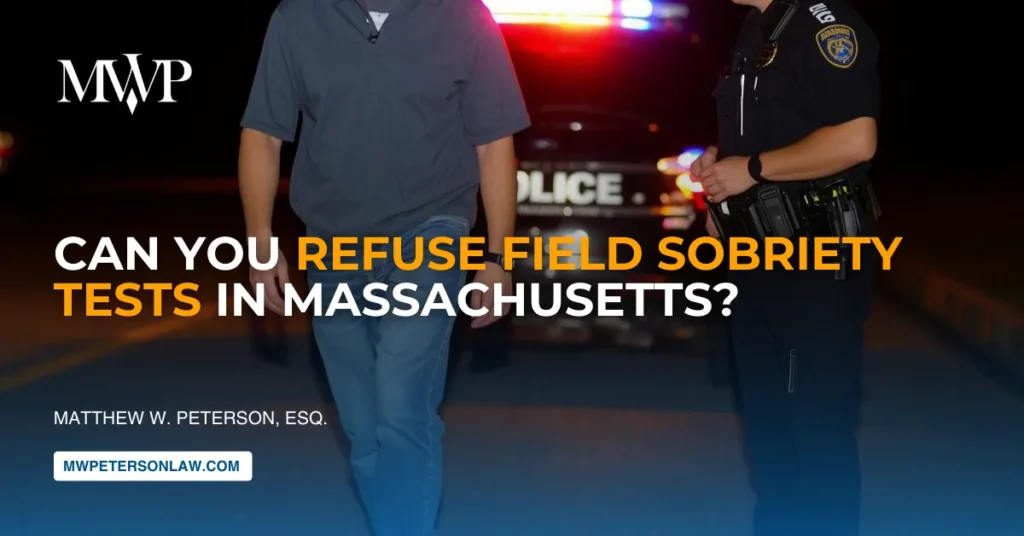
Yes — field sobriety tests are completely voluntary in Massachusetts, and to refuse field sobriety tests cannot be used against you at trial. If you or a family member has recently been through an OUI stop and is wondering whether those roadside tests were required, the answer is no. Here’s what you need to understand about why that matters.
What Are Field Sobriety Tests?
Field sobriety tests (FSTs) are a series of physical and cognitive tasks that police officers use roadside to assess whether a driver may be impaired. The three standardized tests recognized by the National Highway Traffic Safety Administration (NHTSA) are:
- Horizontal Gaze Nystagmus (HGN): The officer asks you to follow a pen or light with your eyes, watching for involuntary eye movement.
- Walk-and-Turn: You walk heel-to-toe in a straight line, turn, and walk back.
- One-Leg Stand: You stand on one leg for approximately 30 seconds.
Officers may also ask you to recite the alphabet, count backwards, or perform other informal roadside tasks. None of these are required.
The Officer Doesn't Have to Tell You They're Voluntary
Most people assume an officer will warn them of their rights before asking them to step out and perform tests. That assumption is wrong. Massachusetts law does not require an officer to inform you that field sobriety tests are optional. The Massachusetts Supreme Judicial Court confirmed this in Commonwealth v. Blais, 428 Mass. 294 (1998). There is no Miranda-style warning before an officer asks you to perform these tests.
That means the burden is on you to know your rights — which is exactly why having this information before you need it matters.
Refusal Cannot Be Used Against You at Trial — But Your Words Can
If you decline to perform field sobriety tests, that refusal is inadmissible at trial. The Massachusetts Supreme Judicial Court established this in Commonwealth v. McGrail, 419 Mass. 774 (1995). The court reasoned that allowing a refusal into evidence would effectively force a defendant to tell the jury: “I’ve had so much to drink that I know — or at least suspect — I cannot pass the test.” That kind of self-incriminating statement has no place in a courtroom.
However, there is a critical distinction that many people miss: the protection covers the refusal itself, not the words you say while refusing.
If you decline the tests but say something like “I can’t do those, I’ve had too much to drink” — that statement is fair game for the prosecution. Your words are not protected the same way your silence is. The officer will write down exactly what you said, and the jury will hear it.
The safest approach is simple: decline politely and say nothing more. You do not need to explain yourself. “No thank you” is a complete answer.
The court reinforced the scope of this protection in Commonwealth v. Grenier, 45 Mass. App. Ct. 58 (1998), ruling that even a defendant’s statement that he could not do the test was inadmissible — but that case turned on its specific facts. Don’t rely on the courts to sort it out after the fact. Keep your refusal short and silent.
No License Penalty for Refusing
Unlike a breathalyzer refusal — which triggers an automatic license suspension under Massachusetts’ implied consent law — refusing field sobriety tests carries no license penalty whatsoever. This is a critical distinction.
You can read more about What Happens if I Refuse a Breath Test in Massachusetts?
If you’re concerned about the breathalyzer question specifically, that topic is covered in full in our companion piece on breathalyzer refusals. Together, these two blogs walk through the complete OUI arrest moment and address the questions nearly every person facing an OUI charge asks first.
Should You Refuse?
Field sobriety tests are not designed to help you. They are investigative tools designed to gather evidence. The officer is watching for clues of impairment, documenting every misstep, and writing it all into a police report that the prosecution will later use at trial.
These tests are also imperfect by nature. Balance and coordination can be affected by nerves, fatigue, a medical condition, footwear, uneven pavement, or simply the stress of being pulled over at night on the side of a road. Sober people fail these tests regularly.
If you have any reason to believe you might not perform well — whether due to impairment, a physical limitation, anxiety, or anything else — refusing is a legally protected option with no license consequences. What the jury never hears cannot be used to convict you.
The key is how you refuse. Stay calm, be polite, and keep it brief. Do not explain your reasoning. Do not apologize. Do not say anything that could later be taken as an admission. Simply decline and stop talking.
Every stop is different, and an officer who has already observed significant signs of impairment may proceed with an arrest regardless. The decision to refuse depends on the specific facts of your situation — which is why speaking with an attorney as early as possible makes a meaningful difference.
Facing an OUI Charge in Massachusetts?
If you or a family member has been charged with OUI, the decisions made at the roadside are not the end of the story. They are the beginning of your defense. An experienced Boston OUI attorney will evaluate what evidence exists, how it was obtained, and where the prosecution’s case has vulnerabilities.
The Law Office of Matthew W. Peterson represents individuals charged with OUI throughout Massachusetts. If you have questions about your case or want to understand your options, call us at 617-391-0060 to schedule a consultation.
This blog is for informational purposes only and does not constitute legal advice. For guidance specific to your situation, contact a qualified Massachusetts OUI attorney.